
7-1 | Table of Contents | DOI 10.17742/IMAGE.NBW.7-1.15 | AuerPDF
Jessica Auer | Photographer
STUDIES ON HOW TO VIEW A LANDSCAPE
The pleasures of photography and landscape came together for me at the same time. Shortly after I turned 10 years old, my parents divorced and, as a consolation, my father bought me a 35mm Nikon camera. He also told me to pack a bag and be ready to leave the next day—that all I needed was a small bag of clothes, a book, and the camera—as I would be travelling with him throughout the summer. Thus began my first road trip and my first photographic mission. Day after day, I experienced a cinematic view of the Canadian landscape from the passenger seat, witnessing subtle changes as we traversed the geography of a diverse country, snapping photos of everything from roadside attractions to black spruce forests and the trains that often glided alongside the Trans Canada Highway. Our arrival in Banff National Park was the most striking experience of the journey. The Rockies were rich in photographic content: colorful lakes, precipitous mountains, spiraling railways, and lots of other people. It was during this first National Park experience that I learned that the significance of landscape was not just about natural vistas but also the culture of nature.
Twelve years later, I found myself once again at the edge of Moraine Lake. As a recent University graduate with a BFA in photography, I looked at the view before me with scrutinizing eyes and a curious mind. The signature mountains of the Valley of Ten Peaks stood in front of me as they had before, but somehow the scene felt unfamiliar. There were certainly signs of cultural development, yet I still questioned how much the landscape had actually changed. On the other hand, how much had I changed?
Over the next decade I returned to Rockies several times, as a retreat from the routine of my predominantly urban life in Montreal, but also to make photographs. Since my student days, my research-based photographic work has been largely concerned with the study of cultural sites, leading me to photograph the impact of tourism on some of the world’s significant places, showing how landscape has been preserved, altered, or commodified for sightseeing. After several years of examining the topic from a photographically objective perspective, I began to understand that the collectivity of my experiences has informed my perspective much more than the viewpoints to which I struggled to hike. Growing weary of repeating the same images I had already produced, I chose to take a few steps back from the traditional viewpoint, to look at the sightseeing phenomenon from a more anthropological perspective.
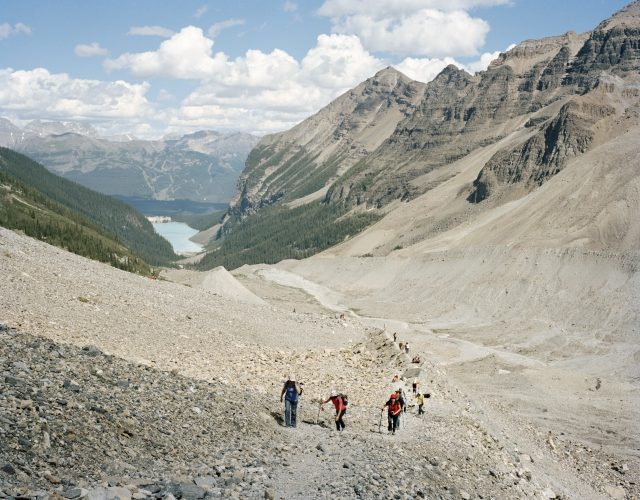
In his seminal book Landscape and Memory, Simon Schama argues that landscape cannot be free of culture and that as viewers we project our own mythologies and perceptions onto nature. During the summer of 2012, I participated in a two-month artist residency at The Banff Centre on Tunnel Mountain. Using photo and video cameras to passively record the gestures and actions of sightseeing tourists, I shifted my focus to the space of the viewer rather than the space being viewed, observing from a human perspective and on a human scale. “Studies on How to View Landscape” shows the landscape in relation to ourselves, the view to a degree still a backdrop onto which we project our curiosities and desires and, to some extent, our inadequacies. Upon leaving these viewpoints we may or may not leave a trace, but we somehow become part of the overall image.
Works Cited
Schama, Simon. Landscape and Memory. New York: Vintage Books, 1996. Print.
Image Notes
Figure 01: ‘Lake Louise #1’, 2010, CHprint,40”x50”
Figure 02: ‘Glacier Experience,’ 2012, CHprint,40”x50”
Figure 03: ‘Lake Louise #2,’2012, CHprint, 40”x50”
Figure 04: ‘Hiking the Plain of Six Glaciers,’ 2012, CHprint, 40”x50”
Figure 05: ‘Lunch at Sentinal Pass,’ 2012, Inkjet Print, 60”x75”
Figure 06: ‘Moraine Lake,’ 2012, HD Video Still
Figure 07: ‘Sulphur Mountain,’ 2012, HD Video Still
Figure 08: ‘Johnson Canyon,’ 2012, HD Video Still
Figure 09: ‘Tunnel Mountain,’ 2012, HD Video Still
Figure 10: ‘Paradise Valley,’ 2012, HD Video Still
Figure 11: Peyto Lake,’ 2012, HD Video Still