

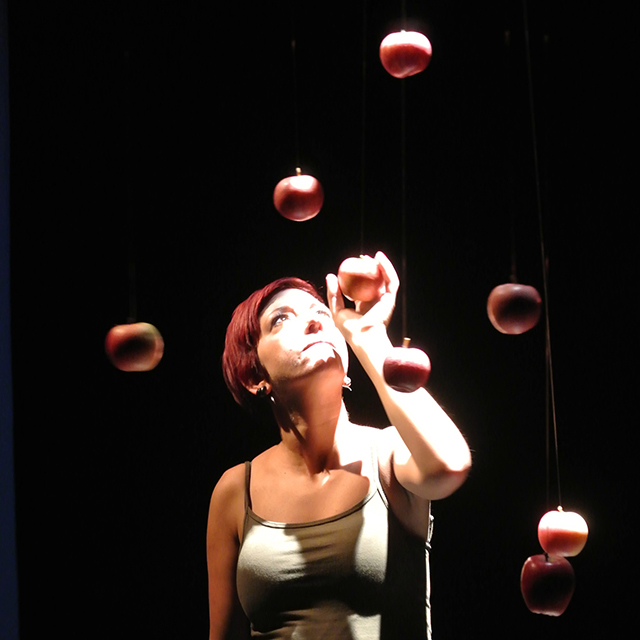
The ambivalence of everyday practice in a state crisis. Scene from the performance, Apples © Bodycrisis / IOD (IMAGE 7) – Click Image to Start Video
On the level of the somatic, our group of performers undertook research in a studio setting that drew attention to the importance of conceptualizing a vital, energetic, accelerated political body. As such, the interviewees framed the everyday as characterized by all sorts of seemingly ordinary practices, a heightened level of energy that further supported restlessness, and a resistance to sleep, thus pushing the limits of the everyday. In our analysis of the interviews this corresponded with remembered practices of hesitation and excessive media consumption, consequently postponing obligations or fulfilling them halfheartedly.
Yet how do we translate this ambivalence of an everyday on the edge, an everyday we have come to understand as precarious but equally stabilized by repeated embodied practice? The live, performing body can generate insight into these parameters by allowing for a provisional and temporally limited identification of the self in others through somatic empathy, situatedness, and avowal of difference. As a result of our performance work, we devised hybrid cultural performance nodes that capture and intersect with the somatic experience from other cultural conflicts and scenarios. These nodes not only reflect back on the analysis of the specific historical experience of 1989-90, but also deflect attention from the extraordinary and unique aspects of the historical situation to focus on common, transcultural parameters for the explication of the relationship between somatic experience, the everyday, and social change.
The following video showcases our aesthetic engagement with the interviews on the precariousness of living through 1989 and grasping embodied quotidian experiences of 1989.