

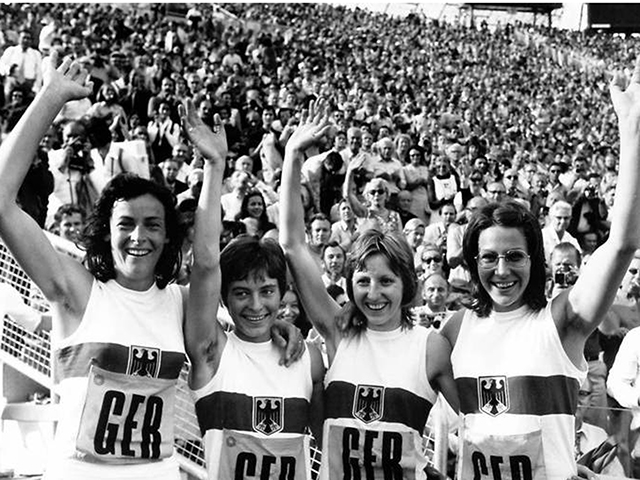
The Olympic team of the FRG, June 1972 © ullstein bild / Tagesspiegel.de (IMAGE 19) – Click Image to Continue
Correspondingly, West German public discourse since the 1970s has seen a strong correlation between feminism and culturally specific politics of the body related to shaving, rather than a permissive attitude toward displays of nudity. This correlation led to a cultural stereotype that still identifies women as lesbians and feminists on grounds that they employ a more “natural” approach to daily body practices, i.e., no body shaving. The cliché says: feminists are hairy and stink (Eisman 628). Needless to say, we have strong evidence to the contrary, for example, images of a female team from West Germany in the 1972 Olympic Games display unshaven armpits. The life circumstances of Ingrid Meckler-Becker, one of the women portrayed in the photo, suggest a non-correlation between unshaven armpits and feminism: she was a conservative party member, married with children, and a schoolteacher. This cultural stereotype based on daily hygiene has gained new momentum to include East Germans in the post-Wall Berlin Republic. It exemplifies the union of fashion-based everyday practices and time-specific politics of the body at work.