

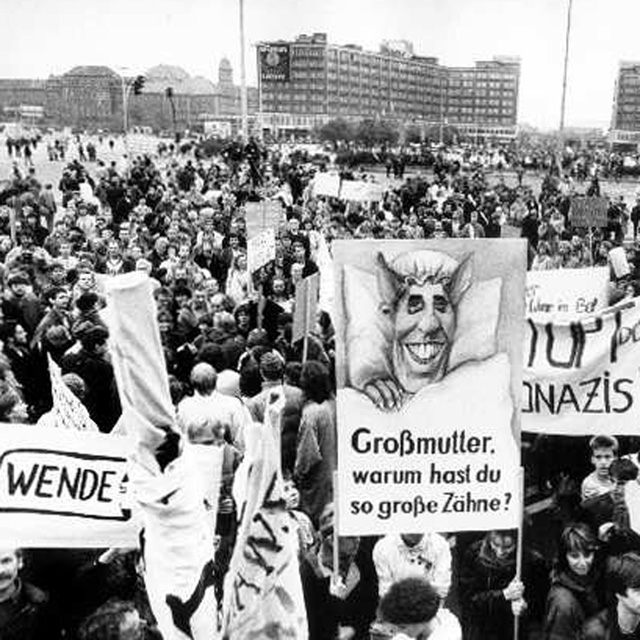
November 4, 1989, Berlin, Alexanderplatz © Andreas Kämper, Robert Havemann Gesellschaft (IMAGE 2) – Click Image to Continue
Twentieth-century German historiography has given the everyday prominence as a space of performing Eigen-Sinn in capturing individual agency vis-à-vis wider sociopolitical demands and state control (Lüdtke 13). In this context, the everyday functioned as a gatekeeper for the reassessment of GDR reality in light of the still dominant totalitarianism approach in historiography (Lindenberger 1). (On the need for a new approach to researching the everyday of the GDR, see Rubin and Ebbrecht-Hartmann in this issue.) In the context of writing and remembering 1989-90, however, the everyday has remained out of focus, as has the individual agent of change. Accordingly, historians have largely analyzed East Germans as a political mass (Grix 3). The image on the right shows one of the most significant demonstrations of East Germans for political reforms, taking place on Berlin Alexanderplatz on November 4, 1989. This image belongs to the canon of documents framing the reality of the Wende.