

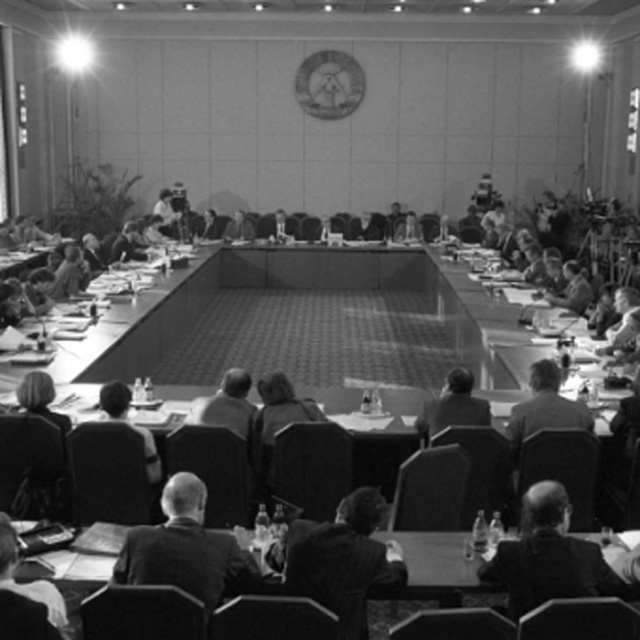
Round Table talks, East Berlin, 1989 © dpa / BAKS (IMAGE 3) – Click Image to Continue
In some cases, historians have turned to examine the everyday of prominent agents for political change, for example, Bärbel Bohley as a leading representative of the GDR civil rights movement (Olivo ix). In short, we know little about how ordinary citizens organized and accomplished the everyday of 1989-90 when confronted with substantial socioeconomic and political change, nor do we know how it is remembered today. The period of the political Wende, 1989-90, disintegrates when employing an everyday approach. Many envision 1989 as the last year of the GDR and thus subsume its everyday under a more generally defined GDR normality that finally came to an end in November 1989. Correspondingly, East Germans woke up to the everyday of the now unified Berlin Republic in October 1990. Accounts following this narrative declared the temporary end of everyday life (Moran 216).